
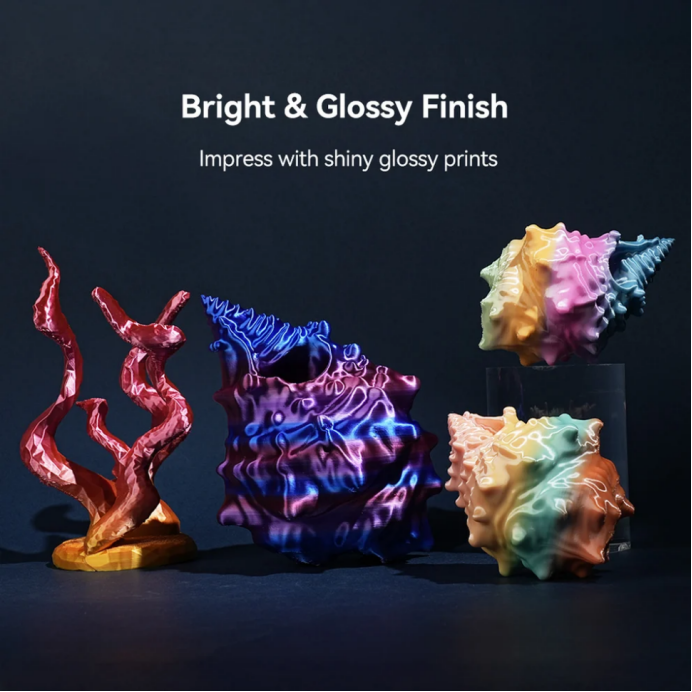
Silk filaments offer the most straightforward printing experience among the three shiny options. The formulation avoids abrasive particles entirely, which means standard brass nozzles can be used without accelerated wear. Glitter variants introduce solid flakes that can act as mild abrasives, while Metallic blends change how heat moves through the plastic. Choosing based on printability rather than appearance alone reduces the risk of nozzle damage and failed prints.
Glitter Particles and Nozzle Wear
Glitter filaments carry small reflective flakes suspended in the polymer. These particles create a scattered, star-like sparkle, but they can also be abrasive against softer nozzle materials. Some glitter products are formulated to be non-abrasive, yet particle-filled blends still deserve a hardware check before a long print. A hardened steel or ruby-tipped nozzle is a practical safeguard for frequent use, and a slightly larger orifice of 0.6 mm can reduce the chance of clogging with heavier particle loads.
The rough surface of these filaments also increases friction in the feed path. The extruder gears must work harder to push the material downward, which raises the risk of grinding the strand flat. Regular inspection of extruder tension becomes part of the routine. These hardware demands mean glitter is not the simplest entry point for a standard desktop setup.
Metallic Powders and Thermal Behavior
Metallic filaments use fine metal powders to achieve an industrial appearance. The presence of metal changes thermal conductivity, so the filament can melt at a different rate than standard PLA. This can lead to inconsistent flow if the hotend temperature is not dialed in carefully. Running too cold may cause partial clogs, while running too hot can make the polymer overly fluid and produce stringing.
Calibrating a temperature tower is a sensible step for metallic blends. The added density of metal-filled spools also places more weight on the spool holder and feeding mechanism. These factors make metallic filaments more demanding than silk, though they remain manageable with proper tuning.
Silk Blends and Frictionless Extrusion
Silk filaments achieve their glossy, satin-like finish through modifications to the polymer formulation rather than relying on solid abrasive additives. Unlike some composite filaments containing abrasive particles, most standard silk formulations can generally be printed through brass nozzles without significant additional nozzle wear. They are also typically compatible with standard extruder gears and, when properly calibrated, can provide relatively consistent material flow. However, printing performance and clogging risk still depend on filament quality, nozzle condition, and temperature settings.
A premium Rainbow Filament combines this smooth extrusion behavior with continuous color transitions. The color change occurs along the strand, so the printed object shifts hue automatically as the extruder consumes material. This visual effect adds interest without adding hardware complexity. For makers who want a decorative result without upgrading their nozzle or wrestling with abrasive fillers, silk-based options are the most forgiving choice.
Thermal Parameters for Clean Glossy Output
Silk Rainbow materials print within a moderate temperature window. A nozzle range of 205–235 °C and a bed temperature of 50–60 °C covers most desktop setups. Lower speeds tend to produce a glossier surface, so slowing down the outer walls can help maximize the sheen.
However, excessive heat introduces stringing, which is more visible on a reflective surface. Retraction distance and travel speed should be tuned to keep the gloss clean. Running a temperature tower with the actual spool identifies the best balance for a specific printer. These adjustments are minor and do not require the nozzle changes that glitter or metallic blends may demand.
Model Design and Visible Color Transitions
The color change in a Rainbow 3D Filament depends on how much material passes through the hotend. Small, thin-walled objects may finish before the pigment shifts noticeably. Larger models, or multiple copies placed on the same build plate, consume enough material to reveal a broader gradient.
Orientation also affects where the transition lands. Rotating a model on the build plate shifts the color phase across different surfaces. Previewing the toolpath in the slicer shows how the hue aligns with the exterior walls.
Material Consistency and Storage
Silk filaments still benefit from consistent manufacturing tolerances. Microscopic fluctuations in diameter can disrupt steady extrusion and cause surface defects on long jobs. Manufacturers such as SUNLU specify filament diameter tolerances and spool quality to help users achieve consistent feeding and extrusion.
Moisture control matters for any PLA-based material. Ambient humidity can cause brittle strands and steam pockets during heating. Sealed storage with desiccant supports a shelf life of one and a half to two years.
While glitter and metallic blends may require additional attention to hardware or printing temperatures, silk filaments offer a different appeal through their smooth, reflective finish and distinctive color effects. With appropriate temperature and speed settings, they can add a glossy, polished appearance to printed models without significantly complicating the printing process.
