
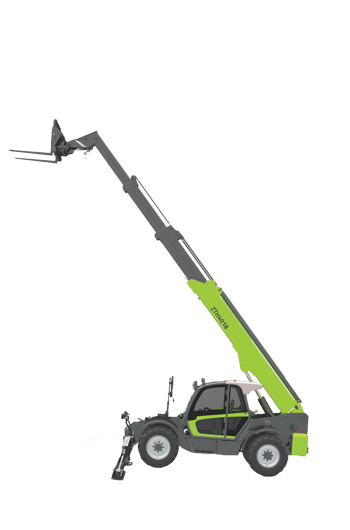
Telehandler procurement requires more than choosing the highest rated capacity or lifting height. An off road telehandler must work within the physical and operational limits of the jobsite, from ground conditions and travel routes to load placement and attachment choice. Buyers also need to understand how capacity changes as the boom extends.
Lift Height Should Match the Placement Task
Lift height should be linked to what the customer needs to place, not simply how high the boom can rise. Pallets may need to reach upper floors, roof areas, or elevated platforms, while capacity can change at different boom positions. Procurement teams should examine load charts and working positions.
Maximum reach is equally important. A telehandler can carry more close to the machine than at greater forward reach. A headline rating alone may not match actual placement requirements, making capacity at different working positions an important purchasing consideration.
Capacity Is a Working Range, Not One Number
Rated capacity provides a starting point, but telehandler performance depends on boom position and the applicable load chart. Buyers should check capacity at maximum height and maximum forward reach, then compare those figures with the heaviest and most distant loads expected on site.
The same principle applies when evaluating a telehandler for construction projects. Pallets, steel components, formwork, masonry materials, and other loads may need to be moved across changing heights and working distances. Buyers should define the load weight, placement height, forward reach, and frequency of handling before selecting the appropriate machine.
Site Conditions Shape the Choice
Terrain can change how useful a telehandler is. Construction sites may involve slopes, unfinished surfaces, temporary roads, or variable ground conditions. Buyers should consider gradeability, ground clearance, traction, steering modes, turning radius, tires, and frame leveling. These factors should be assessed together.
A suitably specified off road telehandler should also be evaluated against access routes and working clearances. Width, height, wheelbase, and turning radius can influence whether a machine reaches different site areas. HSE guidance recommends selecting the right vehicle for the job and site and notes that rough-terrain machines still have operational limits.
Attachments Can Change the Use Case
Attachments can broaden a telehandler’s application range, but they also change the operating configuration. Forks, buckets, work platforms, or other approved implements can have different capacities and requirements. Buyers should confirm that the manufacturer supports the intended attachment and use the correct load chart for the complete configuration.
Attachment planning is also important when comparing construction and agricultural requirements. A buyer looking through listings for an agricultural telehandler for sale may encounter machines presented around different attachment packages. The key question is whether the machine and attachment are rated for the intended load. HSE notes that unsuitable attachments or uses can create serious risks.
Balance Power With Fleet Requirements
Engine power, fuel capacity, transmission type, and hydraulic performance influence a telehandler during repeated material-handling cycles. Procurement teams should connect these specifications with workload and duty cycle. The objective is to match performance with regular tasks.
Fleet buyers should also compare models across several capacity bands. A balanced range can cover lower and higher reach applications, helping dealers match machines to different construction projects without relying on one configuration for every requirement.
The ZTH4018 From Zoomlion Access
The ZTH4018 from Zoomlion Access is a non-rotating telehandler with a maximum lift height of 17.6 m and a rated capacity of 4,000 kg. Its published lift capacity at maximum height is 2,500 kg, while maximum forward reach is 13.4 m with 850 kg lift capacity at maximum reach.
The ZTH4018 has a 6.48 m overall length, 2.28 m width, 2.57 m height, 3.07 m wheelbase, and 0.42 m minimum ground clearance. Its outside turning radius is 3.8 m, with ±10° frame leveling and 71 kN maximum traction force.
Power and Product Specifications
The ZTH4018 uses a Cummins QSF 3.8/Cummins F3.8 engine, with listed rated power of 73/55 kW and maximum torque of 420/400 Nm. It uses hydraulic transmission and has a maximum drive speed of 30/25 km/h.
It also lists front-wheel, four-wheel, and crab steering, 400/80R24 tires, a piston implement pump, 150 L/min flow at 280 bar, and a 145 L hydraulic tank. The standard fork is 1220 mm × 122 mm × 50 mm, with 126° rotation.
Why Zoomlion Access Matters in the Product Mix
Zoomlion Access lists eight telehandler models, including non-rotating models ZTH2506, ZTH3507, ZTH3513, ZTH4014, and ZTH4018, plus rotating models ZTH4518R and ZTH4525R. Across the listed range, maximum lift heights run from 6 m to 24.8 m and rated capacities from 2.5 to 4.5 tonnes.
For construction buyers, the ZTH4018 combines 4,000 kg capacity, 17.6 m lift height, and 13.4 m forward reach. Zoomlion Access also highlights off-road ability and gradeability for this model. Dealers can compare these figures with project requirements and site conditions before recommending a machine.
A More Structured Procurement Process
Telehandler selection becomes clearer when procurement teams work from the load, placement distance, required height, terrain, and access route. An off road telehandler should be matched to its actual duty cycle, while attachment requirements and load charts should be checked for each intended configuration.
The same approach applies when selecting a telehandler for construction projects: compare the machine’s specifications with the actual lifting and placement tasks on site. The ZTH4018 provides defined capacity, height, reach, dimensions, steering, and power specifications. Zoomlion Access offers a broader telehandler portfolio for distinct application requirements.
