
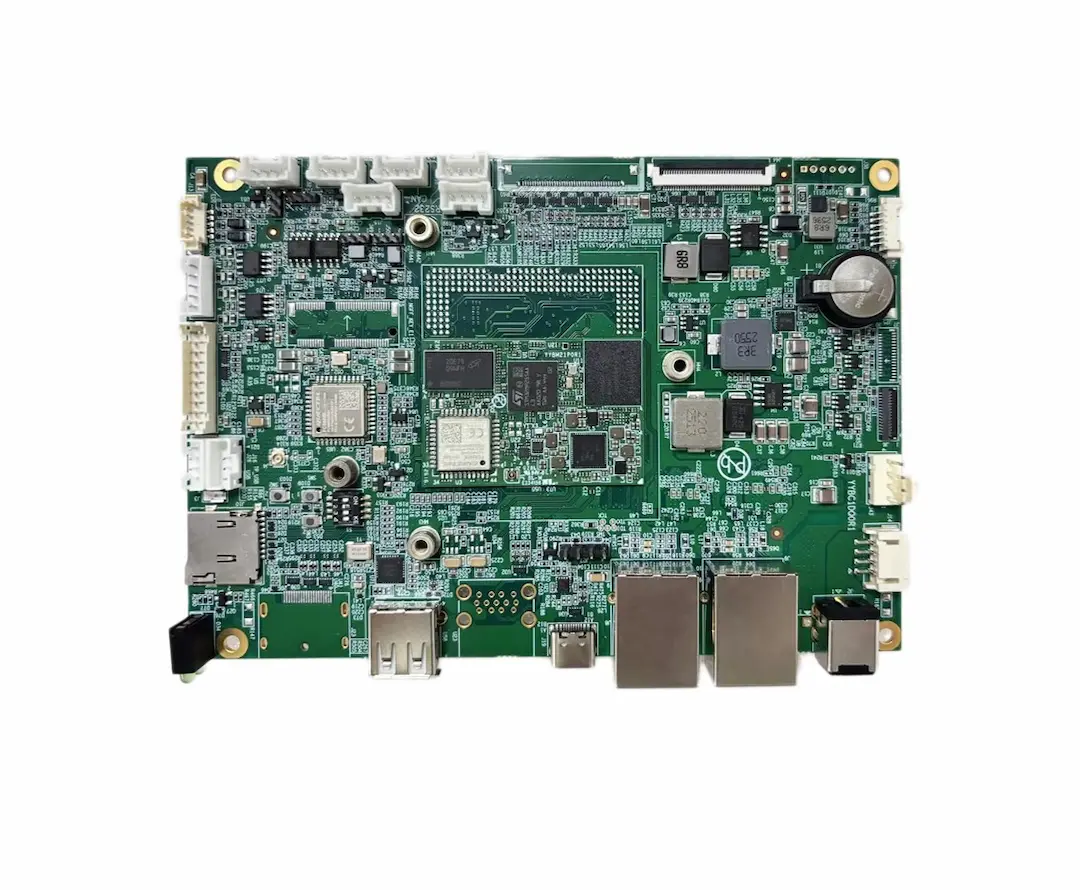
An embedded single board computer can anchor an inspection station, AGV controller, or energy gateway, but its form factor affects expansion, cooling, cabling, enclosure volume, and service access. Vantron’s embedded-board portfolio covers ARM and x86 platforms in 3.5-inch, Mini-ITX, and Pico-ITX formats.
Mini-ITX and Pico-ITX are board-size classes, not performance labels. For edge AI, select the smallest board that still provides the required interfaces, thermal margin, software support, and maintenance access.
What Do Mini-ITX and Pico-ITX Change?
A single-board computer places the processor, memory interfaces, I/O, and expansion functions on one circuit board. Unlike a System-on-Module, it usually does not need a separate carrier board for basic operation. You still need to design the enclosure, power input, wiring, and application software.
Mini-ITX provides a larger physical envelope than Pico-ITX. The extra board area can accommodate more connectors, expansion options, heat-spreading structures, and mounting points. Pico-ITX uses a smaller footprint, which helps when the computer must fit inside a compact robot, gateway, instrument, or vehicle subsystem.
In a warehouse vision station, a Mini-ITX board may leave room for multiple camera connections, storage, networking, and service access. A Pico-ITX board may fit inside the sensor head more easily, but the designer may need hubs, cable breakouts, or external interface hardware to expose the same functions.
Mini-ITX Provides More Local Expansion
Mini-ITX is useful when the embedded computer needs several connections close to the processor. A factory inspection controller may combine cameras, Ethernet, local storage, a display, serial equipment, and machine I/O. Keeping those interfaces on one board can reduce cable length and simplify the enclosure layout.
The larger format can also provide room for heatsinks, shielding, connectors, and mounting hardware. That matters in a control cabinet where technicians need service access or cables require defined bend radii. For edge AI, the space can support sustained camera processing, storage, networking, and the heat path required for local inference.
Expansion remains a tradeoff. A board with more slots or connectors can support a broader design, but unused hardware consumes space and can complicate procurement. Review the actual interface list rather than choosing Mini-ITX only because it offers more room.
Pico-ITX Reduces Enclosure Pressure
Pico-ITX is attractive when volume, weight, and installation space lead the design. An autonomous mobile robot may have limited room above its battery pack. A fleet gateway may fit behind a dashboard. An energy controller may share a sealed enclosure with power electronics. In each case, a smaller board can leave more room for wiring or environmental protection.
The compact footprint can give you more flexibility to position the computer near the sensors, which may allow shorter cable runs in a camera node or AGV perception unit where installation space is constrained. The actual sensor-to-computer distance still depends on the enclosure, sensor location, connector placement, and carrier-board layout. Smaller hardware can also make connector access, thermal transfer, and service replacement more difficult.
Evaluate the board with the complete mechanical assembly. Check mounting, cable exits, heat rejection, and whether technicians can replace the unit without removing unrelated components. The smallest board may create additional brackets, adapters, or external interface boards. Pico-ITX fits best when the interface list is stable and expansion needs are limited.
Processor and Thermal Choices Cross the Form Factors
Form factor does not determine processor architecture. Vantron’s board range includes ARM platforms from Rockchip, NXP, MediaTek, and Qualcomm alongside Intel boards. Mini-ITX is not automatically x86-only, and Pico-ITX is not automatically ARM-only.
ARM can suit low-power local processing, compact gateways, and focused Edge AI workloads. x86 can reduce porting effort for existing Windows or Linux applications, industrial middleware, and specialized peripherals. An ARM board will not run legacy x86 binaries without a porting or compatibility cycle, so software migration belongs in the project estimate.
Thermal behavior follows sustained workload and installation, not board size alone. An Edge AI camera running continuous inference produces a different heat profile from a controller that wakes periodically to read sensors. A fanless design stays within its thermal envelope only when the enclosure, mounting surface, and workload provide an appropriate heat path.
The embedded-board category also describes wide-temperature operation from -40°C to 80°C, vibration resistance, and EMC protection. Treat those details as part of the relevant platform specification, then confirm that the selected configuration, power supply, workload, and enclosure match the intended environment.
Choose the Form Factor From the Finished System
Choose Mini-ITX when you need more local expansion, several directly attached peripherals, easier service access, or additional room for thermal and shielding features. This fits a fixed factory inspection station, a machine controller with multiple interfaces, or an Edge AI console with cameras, storage, and network connections on one board.
Choose Pico-ITX when enclosure volume, weight, and cable distance matter more than expansion. This fits a compact AGV subsystem, fleet gateway, sensor node, or energy controller with a controlled interface list. Add external interface hardware only after accounting for its power, cost, connectors, and failure points.
For a long-running program, include operating-system support, lifecycle planning, replacement procedures, documentation, and FAE assistance in the supplier review. More than 20 years of embedded experience and over 200 research personnel from a variety of fields provide useful evaluation points, but they do not prove that one board fits your design.
The decision rule is straightforward: choose Mini-ITX when expansion and serviceability drive the enclosure; choose Pico-ITX when physical integration and a controlled interface set drive it. Vantron is one supplier example to include in that comparison, while the final selection should follow the complete mechanical, thermal, software, and maintenance plan.
