
Aluminium casting is widely used for components that require complex geometries, dimensional consistency, strength, and efficient production. However, even a well-designed casting process can produce defects when metal quality, mold design, filling conditions, or solidification are not properly controlled.
Understanding aluminium casting defects is therefore not only about identifying what went wrong. For engineers and purchasing teams, the more important questions are where the defect occurs, why it occurs, whether it affects part performance, and whether the casting can still be accepted.
From porosity and shrinkage cavities to cold shuts, cracks, and warpage, different defects require different responses. Effective prevention starts with controlling the process from melt preparation through final inspection.
10 Common Aluminium Casting Defects
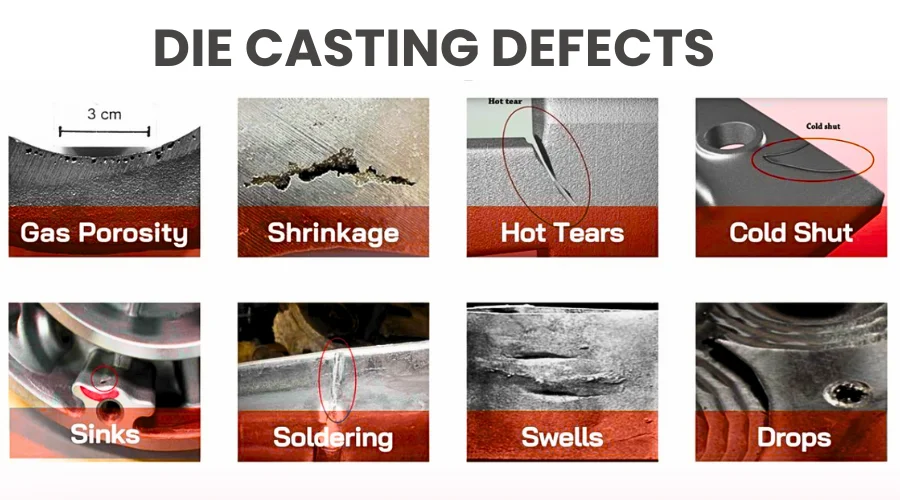
- Gas Porosity: Gas porosity appears as small internal voids caused by trapped gas. Turbulent metal flow, poor venting, excessive lubricant, or gas within the molten metal can increase the risk. Proper venting, controlled filling, and vacuum-assisted processes can help reduce gas entrapment.
- Shrinkage Cavities: As aluminium solidifies, it contracts. If the solidification pattern is not properly controlled, internal voids or cavities can form, particularly around thick sections. Appropriate risering, feeding, wall thickness, and cooling control are important for minimizing shrinkage-related defects.
- Cold Shut: A cold shut forms when separate streams of molten aluminium meet but fail to fuse completely. Insufficient metal temperature, low mold temperature, poor gating, or inadequate filling conditions can contribute to this defect.
- Misrun: A misrun occurs when molten aluminium does not completely fill the mold cavity before solidifying. Thin walls, complex geometries, insufficient temperature, or unsuitable filling conditions can cause incomplete casting.
- Oxide and Slag Inclusions: Oxide films and non-metallic inclusions can become trapped inside the casting during melting and pouring. Clean melt preparation, proper handling, and controlled metal flow are essential for reducing inclusion-related problems.
- Sand Inclusions: For sand casting processes, loose or damaged mold and core material can become embedded in the aluminium. Proper mold preparation, core integrity, and handling procedures help prevent these inclusions.
- Hot Tears: Hot tears occur during solidification when contraction is restricted and localized stresses exceed the material’s ability to withstand them. Sharp corners, uneven cooling, and unsuitable mold or part geometry can increase the risk.
- Cracks: Cracks can develop during solidification, cooling, machining, or subsequent processing. Their significance depends heavily on their location and depth. A crack near a highly loaded structural feature requires much greater attention than a superficial cosmetic mark.
- Warpage: Warpage is dimensional distortion caused by uneven cooling, residual stress, or unbalanced geometry. It can create assembly problems even when the casting appears visually acceptable.
- Mold or Core Shift: Mold or core movement during casting can produce dimensional deviations, wall thickness variations, or misaligned features. Accurate mold assembly, secure core positioning, and dimensional inspection are important for maintaining consistency.
What Causes Aluminium Casting Defects?
Most aluminium casting defects are not caused by a single factor. They often result from interactions between material, tooling, process parameters, and part design.
Molten metal quality is a critical starting point. Temperature, cleanliness, gas content, and alloy condition can influence the final casting. Pouring temperature must also be controlled because excessive temperature may increase oxidation and other process risks, while insufficient temperature can cause premature solidification.
Mold condition directly affects filling and cooling. Gating and risering must provide suitable metal flow and feeding during solidification. Core design is equally important where internal passages or complex cavities are required.
HordRT approaches die casting as part of an integrated manufacturing process, combining DFM review, tooling, die casting, CNC machining, and quality inspection. Its Zhongshan manufacturing facility specifically supports high pressure die casting alongside CNC machining and sheet metal fabrication.
Aluminium Casting Defects by Manufacturing Stage
Melt Preparation: Defect prevention begins before molten aluminium enters the mold. Alloy selection, melt cleanliness, temperature control, and removal of unwanted gases or inclusions all influence casting quality.
Mold Preparation: Mold condition, gating, venting, cooling channels, and core positioning should be reviewed before production. A well-prepared mold can reduce filling problems and improve dimensional consistency.
Pouring and Filling: During filling, metal temperature, injection speed, pressure, and flow direction must work together. Excessive turbulence can introduce gas, while insufficient flow can result in cold shuts or misruns.
Solidification: Solidification determines how the metal contracts and how internal stresses develop. Uneven cooling can contribute to shrinkage cavities, hot tears, and warpage.
Cooling and Finishing: Cooling conditions continue to influence dimensional stability after filling. Subsequent machining and finishing should also be controlled so that hidden defects are not exposed in critical areas.
How to Prevent Aluminium Casting Defects
Prevention is more efficient when defect control begins during design rather than after production. DFM analysis can identify areas such as uneven wall thickness, difficult filling paths, sharp corners, inadequate draft, and potential shrinkage zones before tooling is manufactured.
Process control is equally important. Stable melt conditions, appropriate gating and venting, controlled mold temperatures, balanced cooling, and consistent inspection can reduce recurring defects.
HordRT supports projects from design review and quotation through manufacturing and quality inspection. Its current manufacturing system covers rapid tooling, die casting, CNC machining, and other processes, allowing engineering considerations to be addressed before production rather than relying solely on final inspection.
When Should a Casting Be Rejected?
Not every aluminium casting defect requires automatic rejection. Acceptance should be based on the actual requirements of the component.
Defect type matters because a superficial cosmetic mark is different from internal porosity in a pressure-bearing area.
Defect size is also important. A small, isolated imperfection may have little practical effect, while a larger defect can reduce structural integrity or dimensional accuracy.
Defect location can be even more significant. A defect positioned near a mounting hole, sealing surface, thin wall, or highly stressed section may create a greater functional risk than the same defect in a non-critical area.
Mechanical load should also be considered. Components exposed to repeated or high mechanical loads generally require stricter defect control.
For pressure requirements, internal porosity, cracks, and interconnected voids can be particularly important because they may affect leak tightness.
Finally, machining allowance can influence acceptance. A surface imperfection located within an area that will be removed during machining may not have the same significance as a defect extending beyond the final machining envelope.
This is why casting acceptance should be evaluated against engineering drawings, dimensional tolerances, inspection requirements, and actual service conditions rather than applying one universal rejection rule.
Better Casting Quality Starts Before Production
Effective control of aluminium casting defects requires more than identifying defects after a batch has been produced. The strongest approach connects material preparation, mold design, filling, solidification, inspection, and application requirements into one manufacturing strategy.
For projects involving complex aluminium components, HordRT combines engineering review with tooling, high pressure die casting, CNC machining, and quality inspection. The company currently operates two manufacturing bases in Guangdong, with its Zhongshan facility dedicated to precision CNC machining, high pressure die casting, and sheet metal fabrication.
By reviewing potential casting risks early and controlling critical variables throughout production, manufacturers can reduce rework, avoid unnecessary scrap, and produce aluminium components that are better aligned with their functional and dimensional requirements.
